
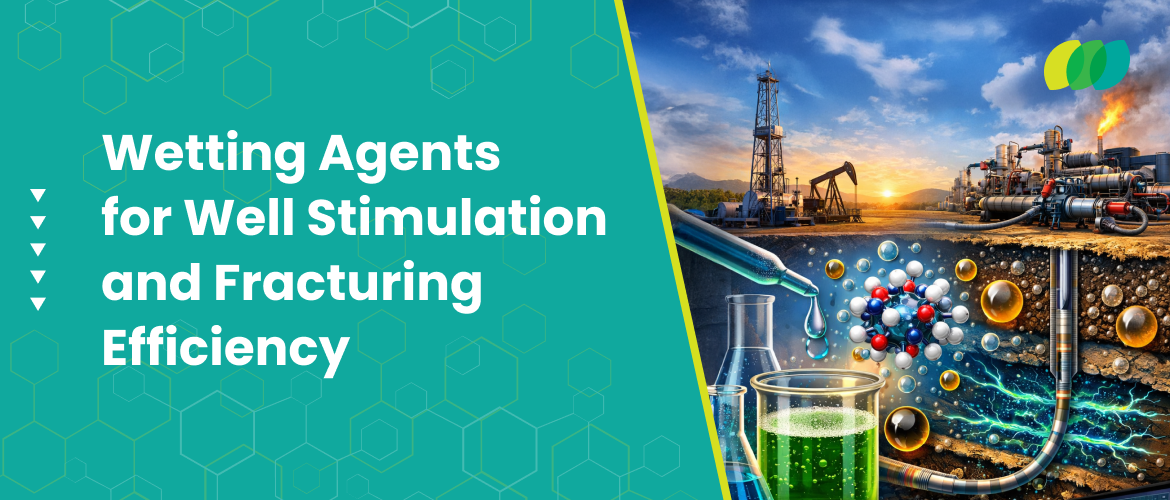
Getting oil and gas out of tight formations has always been challenging. Stimulating a barely permeable rock is a delicate process, and unnecessary repeated treatments should be avoided. Wetting agents help solve this problem. These chemicals change how your treatment fluids behave underground. They work at the molecular level to reduce resistance between fluids and rock.
Production rates improve when you get this right. Most operators focus on pressure and proppant volumes. But the chemistry of your fluids can matter just as much for your final results.
What are Wetting Agents in Well Stimulation?
A wetting agent is a type of surfactant designed for downhole conditions. It changes the way liquids spread across surfaces. Instead of being absorbed, your fluid makes better contact with the formation rock.
What are wetting agents actually doing down there? They have molecules with two different ends. One end is water-loving, while the other end prefers oil. This structure lets them sit right at the boundary between your fluid and the rock face.
When you inject thousands of gallons into a well, efficiency becomes critical. These chemicals make that possible by reducing the natural resistance fluids face when trying to penetrate tight spaces.
Why Does Lower Surface Tension Matter in Stimulation Fluids?
Water naturally resists spreading into small openings. This resistance comes from surface tension. Water has a high surface tension of approximately 72 dynes per centimeter. Surfactants can reduce that figure to 35 or even lower (Source).
The practical effect is significant. Your frac fluid can now enter pore spaces and microfractures that could not reach before.
There is another important benefit that is often overlooked. After the treatment, you want those fluids to flow back out. Lower tension means faster cleanup. Your well starts producing sooner instead of being choked with residual treatment fluid.
How Wetting Agents Enhance Fracturing Efficiency?
Creating a fracture takes enormous pressure. But keeping it productive over months and years requires more than just raw force.
Wetting agents help improve proppant placement within the fracture network. The sand or ceramic beads distribute more evenly through the fracture network. When everything is placed correctly, hydrocarbons can flow through those channels for a long time.
Gas wells face a specific problem called water blocking. Treatment fluids can get trapped by capillary forces in the pore spaces. Surfactants reduce this trapping effect substantially. Your gas can move toward the wellbore without fighting through trapped liquid.
Key Applications of Surfactants in Stimulation Fluids
What do surfactants do in different treatment types? Their uses go beyond basic fracturing jobs.
Acid treatments benefit from better surface contact. Uniform coverage is essential when pumping acid into carbonate rock. Surfactants allow the acid to spread evenly instead of the acid solution following a few spots.
Gel-based systems need to break down after placement. Certain surfactants speed up this process. The gel breaks faster, flowback happens sooner, and production starts earlier.
Nonionic surfactants handle high salt content better than other types. Shale formations often have extreme salinity. These particular chemicals keep working when ionic versions stop functioning.
Types of Surfactants Used in Well Stimulation
Different reservoirs mean different conditions. Temperature, pressure, water chemistry, and rock type vary in each case. Your surfactant choice needs to match these variables.
· Anionic Surfactants
Have a negative charge on their active portion. They work well in many sandstone reservoirs. Cost is usually reasonable. But hard water can cause problems with their performance.
· Nonionic Surfactants
Lack any charge. This neutral character makes them compatible with almost any brine you encounter. They also handle pH swings without breaking down. For unconventional plays, many engineers reach for these first as the best wetting agent option.
· Cationic Surfactants
Carry a positive charge. You see them less often in frac jobs. But they help with clay stability issues. The positive charge attracts them to negatively charged clay particles.
· Amphoteric Surfactants
Switch between positive and negative based on pH. This flexibility helps in complex fluid recipes. They adapt to changing conditions as the fluid moves through different zones.
The nonionic wetting agent category keeps gaining market share. Their tolerance for dissolved salts gives them real advantages in current drilling targets.
Why High-Performance Surfactants Matter for the Future of Well Stimulation
Shale and tight sand reservoirs do not give up hydrocarbons easily. Permeability can be measured in nanodarcies. Every technical edge you can find affects your economics.
Newer surfactant products are engineered for extreme conditions. Some of them operate effectively in brines with salt concentrations that would render older chemistries ineffective.
Environmental regulations are becoming increasingly strict. Biodegradable products reduce compliance-related concerns. Some operators are switching to greener formations even before regulations require it.
The cost argument has shifted, too. Paying more for a superior wetting agent makes sense when it adds meaningful production. Calculate the cost per incremental barrel. That number tells you what really matters financially.
Conclusion
Modern well stimulation depends on getting the chemistry right. Wetting agents directly affect whether your treatment succeeds or underperforms.
The difference between average and outstanding results is often just these details. As the easy reservoirs are being depleted, formations are becoming tighter. Chemical performance is getting more important when you are at the limit of what is technically possible.