
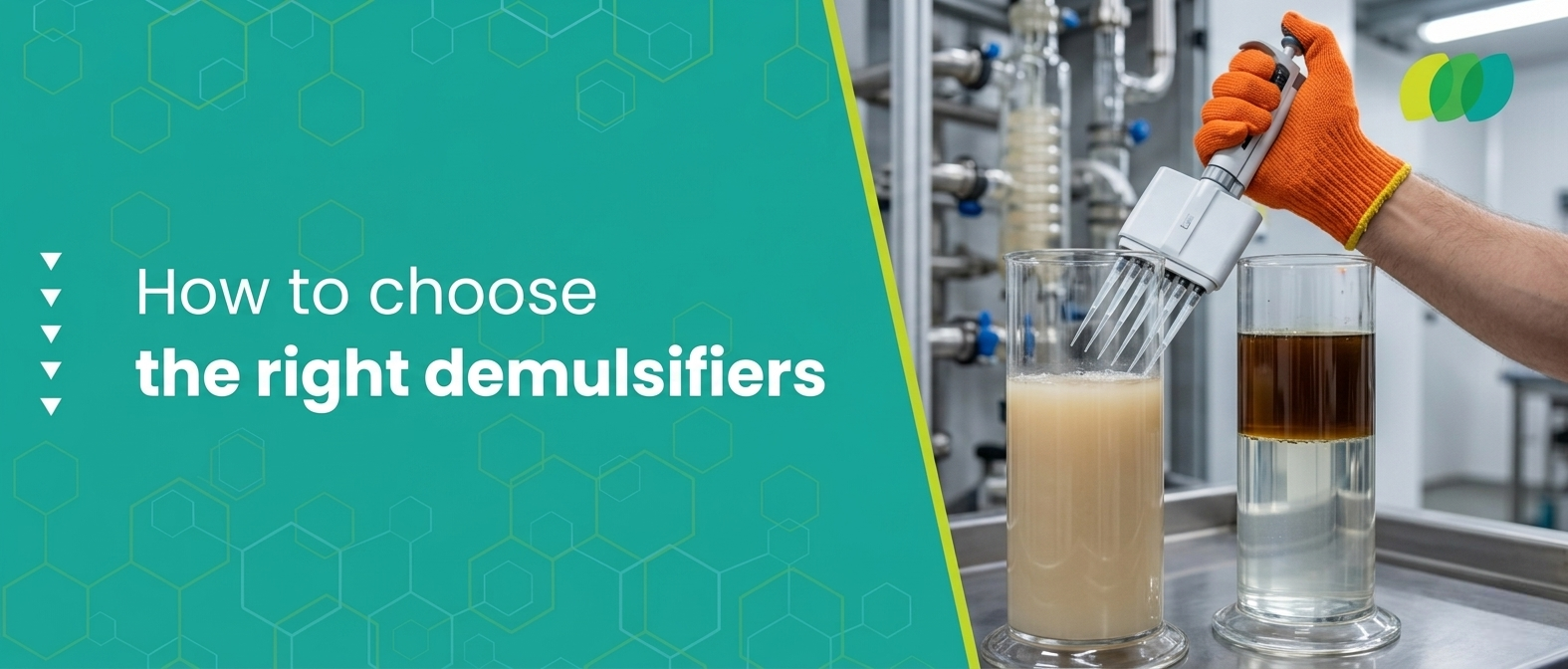
Every barrel of crude oil carries water — and that water doesn’t leave quietly. It binds with oil to form stubborn emulsions that resist separation, choke processing lines, corrode equipment, and silently drain margins. The oil and gas industry loses millions every year from one avoidable mistake: using the wrong demulsifier chemical for the specific crude and field conditions at hand. Thus, the selection of the right demulsifier chemical is very crucial.
Every crude is different. The right demulsifier depends on your exact field conditions — describe yours here and get a recommendation that actually fits.
What Makes Demulsifiers Essential in Oil and Gas?
Crude oil extraction rarely delivers clean oil. What are demulsifiers, exactly? They are specialty chemical additives — also called demulsifier additives — that break the stabilizing interfacial film holding oil and water together, allowing water droplets to coalesce and settle cleanly. In demulsifier oil and gas applications, this function is non-negotiable.
What is demulsifier in oil and gas beyond the textbook definition? It is the chemical line of defense standing between your crude stream and costly processing failures. Operations that begin with a field-specific demulsifier assessment — one that accounts for actual crude chemistry, water cut, and temperature conditions — consistently outperform those that treat chemical selection as an afterthought.
The importance of demulsifier in oil and gas becomes most visible at the refinery gate. Refineries demand crude with less than 0.5% BS&W (Basic Sediment and Water). Failing to meet that standard costs operators financially and reputationally. According to the Society of Petroleum Engineers (SPE), emulsion management ranks among the leading contributors to upstream production efficiency losses worldwide.
Understanding Emulsion Types Before Selection
Effective oilfield demulsifier selection starts with understanding emulsion chemistry. Not all emulsions behave the same — and treating them the same is one of the most common and expensive mistakes in oilfield operations.
Water-in-Oil (W/O) Emulsions: Water droplets disperse within the oil phase. This type dominates upstream production, forming during extraction and transportation. Most demulsifier oil and gas formulations target this emulsion type specifically.
Oil-in-Water (O/W) Emulsions: Oil droplets disperse within the water phase. This appears more frequently in produced water treatment and downstream refining operations. Reverse demulsifiers handle this category.
Complex or Multiple Emulsions: These contain emulsions within emulsions. Heavy crude and aged production streams frequently produce them. They require specialized, high-performance demulsifier chemicals and precise dosage management to resolve effectively.
Key Factors in Selecting the Right Demulsifier
No single oilfield demulsifier works universally. Selecting the correct one demands evaluating multiple operational and chemical variables simultaneously.
Crude Oil Characteristics — API gravity, asphaltene content, and wax levels determine demulsifier compatibility. Heavy, asphaltene-rich crudes demand more aggressive formulations.
Water Cut Percentage — Higher water cuts require stronger or specifically formulated demulsifier chemicals. A product that works at 20% water cut may fail entirely at 60%.
Temperature Conditions — Demulsifier additives perform differently across temperature ranges. Some require heat activation; others work efficiently at ambient field conditions.
Salinity and pH Levels — Produced water chemistry directly impacts demulsifier additive performance. High salinity or extreme pH alters the interfacial chemistry the product must overcome.
Injection Point — Whether the demulsifier injects at the wellhead, flowline, or separator significantly affects residence time and separation quality.
Residence Time — Adequate contact time between the demulsifier and the emulsion is critical. Insufficient time leads to incomplete separation regardless of product quality.
Dosage Requirements — Optimal dosage balances cost with performance. Overdosing can re-stabilize emulsions and trigger costly reverse emulsion problems.
Selecting the Ideal Demulsifier: A Practical Decision Framework
The right oilfield demulsifier matches product chemistry with field reality. No two wells are exactly alike — and no off-the-shelf selection process substitutes for proper evaluation.
Start with a bottle test. This laboratory procedure compares multiple demulsifier candidates against actual field samples, measuring water drop speed, interface clarity, and separation quality under controlled conditions. It is the gold standard before any field-scale commitment.
Next, consider chemical base formulation. Polyglycol esters perform well for lighter crudes. Ethoxylated resins handle heavier, asphaltene-rich emulsions more effectively. Blended formulations address complex or multiple emulsion systems.
Field trials follow successful bottle tests. They validate laboratory findings under real operating conditions. Monitor separation efficiency, produced water quality, and chemical consumption throughout the trial period.
When it’s time to buy demulsifiers for your operation, the supply partner matters as much as the product. A knowledgeable demulsifier supplier provides custom formulations, technical support, and ongoing dosage optimization — not simply a drum of chemical and an invoice.
Demulsifier Selection Guide by Crude Oil Type
| Crude Type | Emulsion Tendency | Recommended Base | Dosage Range (ppm) | Key Consideration |
| Light Crude (>31 API) | Low to Moderate | Polyglycol Esters | 5-25 | Fast separation |
| Medium Crude (22–31 API) | Moderate | Ethoxylated Phenolics | 15-50 | Balanced performance |
| Heavy Crude (<22 API) | High | Ethoxylated Resins | 30–100 | High asphaltene handling |
| Extra Heavy / Bitumen | Very High | Blended Formulations | 50–200+ | Heat + chemical required |
| High-Wax Crude | Moderate to High | Modified Polyamines | 20–60 | Temperature-sensitive |
How Bottle Testing Guides Demulsifier Selection
The bottle test remains the most reliable method for demulsifier chemical evaluation before full-scale deployment. It removes guesswork and protects against expensive field failures.
- Collect representative crude oil and produced water samples directly from the field.
- Heat samples to the actual operating temperature of the separation equipment.
- Add varying dosages of multiple demulsifier additive candidates.
- Observe water drop rates at 5, 10, 15, and 30-minute intervals.
- Evaluate interface quality, produced water clarity, and any rag layer or sludge formation.
A well-executed bottle test identifies the optimal product and dosage before bulk purchase. It consistently delivers higher ROI than trial-and-error approaches carried out in the field.
Common Mistakes When Choosing a Demulsifier
Many operations face recurring demulsifier failures because of avoidable selection errors. Identifying these mistakes prevents compounding cost and downtime.
- Using the same oilfield demulsifier across different wells without individual testing for each.
- Ignoring seasonal temperature shifts that alter emulsion stability and product performance.
- Overdosing the demulsifier inadvertently creates reverse emulsions.
- Selecting based on unit price alone rather than verified performance data.
- Failing to re-evaluate the chemical program as crude characteristics change over the field life.
The U.S. Department of Energy’s Office of Oil and Natural Gas consistently identifies chemical program optimization as one of the highest-ROI interventions available to upstream oil and gas producers.
The Role of Demulsifiers in Upstream and Downstream Operations
Upstream Applications
Upstream operations encounter water-in-oil emulsions at the wellhead. Injecting demulsifier oil and gas solutions early — at the wellhead or flowline — prevents tight emulsions from forming and hardening downstream. This reduces treater temperatures, lowers energy consumption, and minimizes corrosion throughout pipelines and processing equipment.
Downstream Applications
Refineries rely on demulsifier chemicals in desalting operations. The desalter removes salts, metals, and sediment before distillation. A well-chosen demulsifier improves desalter efficiency and protects downstream equipment from fouling and corrosion. Downstream selection requires compatibility testing — the chemical must perform without interfering with other active refinery additives.
Benefits of Working with an Experienced Demulsifier Manufacturer
The right supply partner transforms demulsifier performance across the entire production chain. Technical expertise matters as much as product quality.
- Custom formulations tailored to specific crude chemistry, water cut, and field conditions.
- On-site technical support for bottle testing, field trials, and ongoing dosage optimization.
- Continuous monitoring programs that reduce chemical consumption and control cost.
- Consistent batch quality ensuring predictable separation performance across every shipment.
- Reliable logistics and full regulatory documentation for domestic and international supply.
A trusted demulsifier manufacturer brings more than product to the table — they bring the technical depth to solve your specific separation challenge. The difference between a chemical vendor and a true formulation partner shows up directly in your BS&W numbers and your bottom line.
Environmental and Regulatory Considerations
Modern demulsifier oil and gas selection must account for evolving environmental standards. Produced water discharge regulations vary significantly by region and continue tightening globally. The chosen demulsifier chemical must not introduce harmful residuals into produced water streams or the surrounding environment.
Biodegradable demulsifier formulations are gaining rapid demand worldwide as regulatory scrutiny intensifies. Operators must verify that their chemical program meets local, national, and international compliance standards — not just at onboarding, but continuously throughout the product lifecycle. Green chemistry innovations are now delivering high-performance demulsifier additives with significantly lower toxicity profiles and improved environmental compatibility.
When to Re-evaluate or Switch Your Demulsifier
Demulsifier oil and gas performance can decline quietly as reservoir conditions evolve. Proactive re-evaluation prevents gradual performance failure from becoming a full operational crisis. Watch for these warning signs:
- Increasing BS&W levels in treated crude despite consistent demulsifier dosing.
- Rising chemical consumption without proportional improvement in separation quality.
- Changes in crude API gravity, viscosity, or water cut percentage.
- Significant rag layer buildup in separators or treaters.
- New environmental regulations require lower-toxicity chemical programs.
When these indicators appear, act immediately. Every day of delayed re-evaluation adds cost and risk. Partnering with a supplier who monitors your performance proactively prevents these situations from escalating.
Global Sourcing: Working with a Demulsifier Exporter
Oil and gas operations span continents. Sourcing demulsifier chemicals from a capable global partner ensures consistent supply regardless of where your operations are located. A proven demulsifier exporter manages international logistics, regulatory compliance, and documentation efficiently — so your chemical supply chain never becomes an operational bottleneck.
When operations require cross-border delivery, partnering with an export-capable supplier simplifies procurement and guarantees product arrives on time, to specification, and with full compliance documentation in place.
Conclusion
Choosing the right demulsifier oil and gas solution is not a one-time decision — it is an ongoing process of evaluation, optimization, and adaptation as your crude and field conditions evolve. Every variable matters: crude gravity, water cut, temperature, salinity, injection point, and dosage. Getting anyone wrong can undermine an otherwise sound chemical program.
If your operation is facing rising BS&W levels, unexplained rag layer buildup, or escalating chemical costs, the answer is rarely more chemical — it’s the right chemical, properly evaluated, and optimized for your specific conditions.
Minal Specialities brings deep oilfield chemical expertise, custom demulsifier additive formulations, and dedicated technical support to operations worldwide. Whether you’re looking to buy demulsifiers for a new field development, optimize an existing chemical program, or troubleshoot persistent separation challenges — the team at Minal Specialities has the chemistry and field experience to resolve it.
Frequently Asked Questions
1. Where can I buy demulsifiers for oilfield applications?
You can buy demulsifiers from Minal Specialities — a formulation-focused oilfield chemical supplier offering custom products, technical support, and reliable global supply. Contact us to discuss your specific field requirements.
2. What is a demulsifier used in the oil and gas industry?
A demulsifier is a specialty chemical additive that breaks oil-water emulsions formed during crude oil production and processing. It enables efficient separation of water from oil, helping meet pipeline and refinery BS&W specifications.
3. What are demulsifiers, and how do they work?
Demulsifiers are surface-active chemicals that destabilize the protective film at the oil-water interface. This allows dispersed water droplets to coalesce and settle, producing clean, pipeline-ready crude oil.
4. How does a bottle test help in demulsifier selection?
A bottle test evaluates multiple demulsifier candidates against actual field samples under controlled conditions. It identifies the best-performing product and optimal dosage before committing to full-scale application.
5. Can one demulsifier work for all crude oil types?
No. Different crude oils form different emulsions based on asphaltene content, API gravity, wax levels, and produced water chemistry. Each requires a demulsifier formulation matched to its specific conditions.
6. What happens if the wrong demulsifier is applied?
Incorrect selection leads to incomplete separation, rag layer buildup, rising BS&W levels, and escalating chemical costs. It can also create reverse emulsions that worsen the problem significantly.
7. When should I re-evaluate my demulsifier program?
Review demulsifier performance quarterly or whenever crude characteristics change. Rising BS&W levels, increased chemical consumption, or new regulatory requirements are clear signals to act.