
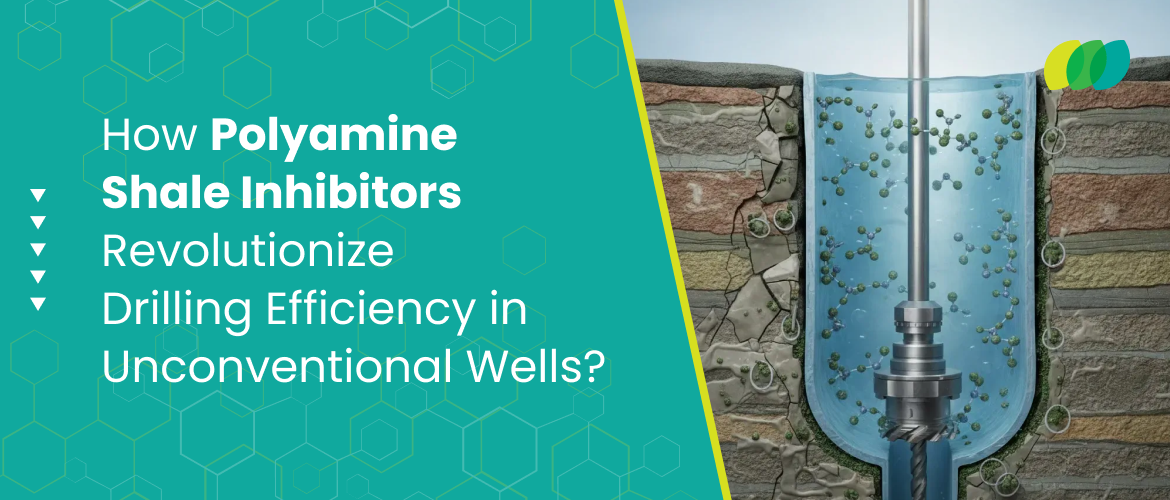
Shale drilling has grown fast, but one problem keeps showing up. Water gets into the formation and causes swelling. The wellbore becomes unstable. Operations slow down or stop completely.
To overcome this challenge, polyamine shale inhibitors are widely used in modern drilling fluids. They help protect shale formations by minimizing hydration and maintaining wellbore integrity.
Polyamines are different from older inhibitors. They bond to the clay surface and block water interaction before any reaction can begin. This prevents the formation from fracturing and allows drilling to proceed without any delays.
Understanding Shale Hydration
Shale hydration occurs when water-based drilling fluids interact with clay minerals in the formation. These clays absorb water, causing them to swell and lose structural strength. As the clay expands, it weakens the surrounding rock, leading to wellbore instability and operational disruptions if not properly controlled.
Why Shale Hydration Causes Wellbore Instability?
Shale formations contain clay minerals that react with water molecules when exposed to drilling fluids. This reaction causes the clay structure to expand and weaken the formation around the wellbore. This occurs because water molecules enter the interlayer spaces of clay minerals, particularly smectite clays.
When water-based drilling fluids contact shale formations, two types of swelling occur. The first is crystalline swelling, which occurs when water molecules bind to clay surfaces via hydrogen bonding. This creates a limited expansion of about 10 to 22 angstroms. The second type is osmotic swelling, which results from ion concentration differences between the clay interlayers and the surrounding fluid. Osmotic swelling can cause severe volume increases, reaching up to 130 angstroms in highly expansive clay.
The hydration process damages the mechanical strength of shale. Field observations show that shale samples immersed in water for 96 hours experience strength reductions between 28% and 40%. This weakening leads to wellbore instability problems, including hole enlargement, stuck pipe incidents, and complete borehole collapse in severe cases.
How Polyamine Chemistry Works?
Polyamines are molecules built with multiple amine groups that carry positive charges in water. Shale clays are negatively charged. When you add polyamines to drilling fluid, they move toward the clay surfaces and bond there through electric attraction.
What happens next is where the real benefit shows up. The polyamine molecule does not just sit on the surface. It blocks the spots where water would normally attach. Water needs those attachment points to penetrate the clay structure. Without access, it stays in the fluid instead of entering the formation.
There is also a hydrophobic component to how polyamines work. Parts of the molecule are hydrophobic. After the polyamine binds to the clay, these hydrophobic segments orient outward. This forms a second obstacle. Even if some water molecules approach the clay surface, they encounter a chemical environment that pushes them away.
Lab work confirms this. Sodium montmorillonite treated with a 3% polyamine solution shows reduced interlayer spacing. The spacing drops to levels you would see with diesel treatment. That tells you water is not getting in. The clay stays compressed instead of expanding.
Polyamines Encapsulation Mechanism
Polyamines create a multi-layered shield on shale particles and drill cuttings. The initial layer is created due to direct chemical bonding between positively charged amine groups and negatively charged clay surfaces. This provides an initial stabilization effect.
Once the initial layer forms, more polyamine molecules accumulate through molecular contact. The hydrophobic regions of these molecules point outward, away from the clay surface. This alignment formulates a water-repellent envelope on the shale particle.
The protective coating also strengthens the exposed wellbore wall. The polymer network formed by polyamine molecules reinforces the near-wellbore rock matrix. Testing shows that shale cores treated with a 1% polyamine inhibitor maintain compressive strengths of around 178 MPa, whereas untreated cores fail at much lower stresses after water exposure.
Performance Advantages in Unconventional Drilling
Polyamine inhibitors deliver measurable improvements in drilling operations. The rate of penetration increases by approximately 41% compared to traditional potassium-based systems in shale formations. This acceleration comes from better hole cleaning and reduced bit balling, as encapsulated cuttings do not stick to drilling tools.
The drilling period shortens as nonproductive time decreases due to fewer stuck pipe incidents and wellbore collapse issues. The lubrication performance of polyamine systems matches or exceeds oil-based drilling fluids. Long-term wear tests show that polyamine drilling fluids maintain stable friction coefficients throughout extended testing periods. This consistent lubrication protects drilling equipment and enables longer bit runs between trips.
Operational Considerations for Implementation
Most operators use polyamine in small concentrations. The right amount depends on what you are drilling through. High-clay formations need more. Low-reactivity shales require smaller dosages. Running a few lab tests on core samples before you drill gives you a baseline to start from.
Polyamines mix well with other fluid additives. You can run them alongside viscosifiers, fluid loss agents, and barite without compatibility issues. The fluid rheology stays stable. This makes field adjustments easier because you are not reformulating the entire system when you add polyamine.
Temperature matters. Standard polyamine formulations hold up well in moderate-temperature wells. However, when drilling in high-pressure, high-temperature conditions, a different formulation with higher thermal stability is required. Heat-resistant polyamine formulations are used in wells operating at temperatures exceeding 150°C.
Testing during operation helps you stay on course. Linear swelling tests and shale dispersion checks indicate whether the inhibitor concentration remains effective. If cuttings begin to break down or the wellbore diameter widens, you know you need to adjust treatment levels. Continual monitoring prevents issues from becoming stuck-pipe problems.
Conclusion
Shale hydration-induced wellbore instability has always been costly. Polyamines address it at the chemical level by preventing water from contacting clay surfaces in the first place.
They result in fewer stuck pipe incidents and improved hole conditions for operators. The formations remain intact longer. Drilling is quicker.
For decision makers considering unconventional projects, polyamines are worth considering because they directly decrease one of the largest contributors to nonproductive time in reactive shale environments.